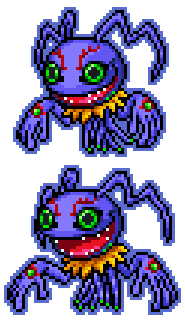
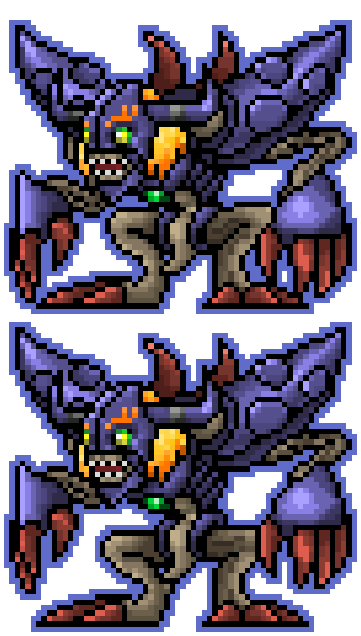
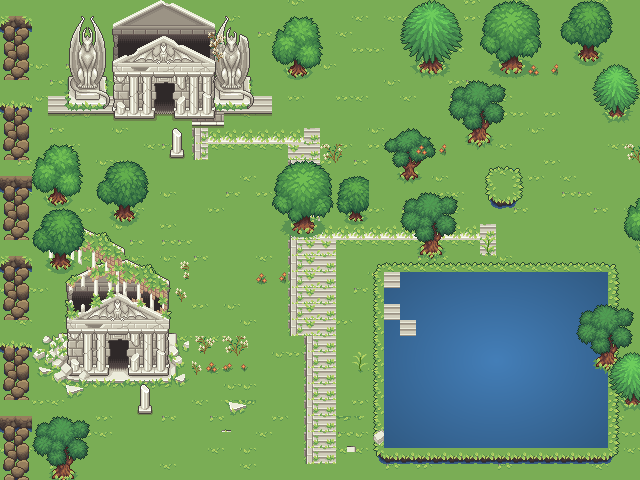
In the previous post, I explained why the original architecture of virtual pets floating over X11 windows hit a conceptual wall: the world needed to be a living organism. Not a static backdrop across which sprites wander, but an emergent system that breathes, grows, corrupts, and competes for computational resources.
To solve this challenge, I turned to one of the most elegant mathematical models in computer science: John Horton Conway’s Game of Life (1970).
At first glance, a deterministic zero-player cellular automaton of zeroes and ones seems worlds apart from an RPG or monster-raising game. Yet, when you examine Conway’s four classic rules—underpopulation, survival, overcrowding, and reproduction—you realize they describe the dynamics of an untamed ecosystem with astonishing fidelity.
In this article, I want to unpack how I designed the mathematical rules of Digi-Life and developed the procedural Python pipeline to render all canonical biomes of legendary File Island in crisp 16-bit retro graphics.
1. The Adapted Conway Rules: “Digi-Life”
In the classic Conway automaton, each cell on a two-dimensional grid has two states: alive or dead. In Digi-Life, a cell can hold multiple discrete cyber-ecological states:
EMPTY: Free memory slot.DATA_BIT: Residual data scraps that act as baseline foraging fodder.MEAT: Dense blocks of digital protein generated by a Tamer or dropped when a wild specimen expires.GLITCH: Corrupted cell or bio-waste (poop), an inert obstacle emitting toxic entropy.DIGIMON_CELL: Occupied by a living entity (tracking Hunger, HP, DP, and Attribute stats).
On each simulation step (Tick), the engine computes the Moore neighborhood (the 8 adjacent cells). The biological rules directly translate Conway’s axioms:
1 | [ NW ] [ N ] [ NE ] |
| Neighbor Condition | Conway State | Digi-Life Phenomenon | Biological Impact on Digimon |
|---|---|---|---|
| 0 or 1 neighbor | Underpopulation (Loneliness) | Isolation & Depression | Hunger plunges; DP drains at 2x rate. If prolonged, the entity collapses and dissolves into raw data. |
| 2 or 3 neighbors | Survival (Equilibrium) | Stable Pack | Digimon share forage resources. Metabolism stabilizes and passive EXP accumulates without stress. |
| 4 or more neighbors | Overcrowding (Overpopulation) | Territorial Clash | Resource collapse. Aggressive infighting triggers injuries and infects the ground with Glitches. |
| Empty cell bordered by exactly 3 adults | Reproduction (Birth) | Data Condensation | Local packet density condenses residual memory into a Digitama (Digi-Egg), hatching on the next cycle. |
The following Python snippet illustrates how the grid evaluator computes this evolutionary step on the board:
1 | def evaluate_digi_life_tick(grid, x, y): |
2. The Attribute Triangle as Cellular Physics Modifiers
In the Digimon franchise, the three fundamental attributes are Data, Virus, and Vaccine. Traditional games treat them as a rock-paper-scissors damage multiplier. In a cellular automaton, however, these attributes redefine the physical laws of survival:
DATA Attribute (Homeostasis):
The guardians of mathematical order. They adhere to Conway’s rules to the letter. Their movement heuristic prioritizes maintaining exactly 2 or 3 neighbors. If an area becomes overcrowded, they migrate in coordinated formations toward sectors with lower entropy.VIRUS Attribute (Chaos & Predation):
They shatter the underpopulation rule: they suffer no penalties from isolation, allowing them to thrive as solitary predators or marginal parasites. When a Virus specimen comes into contact with a Data cell, it siphons HP to replenish its own Hunger gauge. Furthermore, the presence of corrupted cells (Glitches) does not sicken Virus types; on the contrary, it regenerates their energy.VACCINE Attribute (Systemic Antibodies):
Their natural spawn chance increases exponentially when the density of Virus cells in a biome exceeds a critical threshold. Algorithmically, they operate as white blood cells: upon detecting a Virus surge, they don’t panic or flee—they enter hunt mode to purge the infection from the sector.
3. Family Ethology: Social Rules Across the Map
Beyond the three primary attributes, gregarious behaviors are governed by affiliation with the canonical Digimon families:
Virus Busters (Holy) vs. Nightmare Soldiers (Dark):
Demon-type Digimon passively rot walkable tiles as they tread, leaving behind a trail of corruption. Conversely, Holy Digimon act as digital purifiers: they cleanse Glitches upon stepping on them. If a Holy Digimon detects a Demon within its scan radius, it overrides hunger priorities and plots an intercept vector to eradicate it.Dragon’s Roar vs. Nature Spirits (Clan Wars):
Fiercely loyal to their own subspecies. A pack of 3 Greymon tolerates kin, but stumbling into a pack of 3 Garurumon shatters Conway’s equilibrium: stress spikes to 100%, sparking clan warfare where the defeated side is violently driven from the region.Metal Empire (Cyborgs / Recyclers):
Cold, calculating automatons immune to solitude. Their diet is non-biological: their pathfinding logic hunts for and consumes scrap metal and inert data left behind by third-party skirmishes.
4. Evolutionary Pressure: Conway Patterns Dictate Species
In traditional V-Pets, feeding and training a creature according to a static lookup table produces a predictable evolution. In our cellular automaton, the mathematical geometry of the surrounding biome exerts Darwinian pressure on the specimen:
- Biomes Dominated by Gliders:
Gliders traverse diagonally across the grid every 4 ticks. Digimon must run constantly to intercept them for food. This maximizes Speed while driving down Weight, favoring agile or quadrupedal branches (e.g., Garurumon). - Biomes of Still Lifes:
Static, dense data deposits (such as blocks, beehives, or loafs). Effortless, immobile food. The Digimon expends minimal kinetic energy, rapidly gains weight, and builds Defense, evolving into biological tanks (e.g., Ankylomon or Monochromon). - Chaotic Zones & Glitch Swamps:
When a Tamer neglects an ecosystem and overcrowding creates seas of waste and bacteria, creatures inhale corrupt packets. Evolutionary pressure collapses into mutant sewer species (e.g., Numemon, Sukamon, Raremon). - Oscillator Havens:
Rhythmic systems with clockwork periods (blinker, pulsar, toad). They represent pure mathematical network harmony. They encourage balanced data absorption and high Discipline, steering evolutions toward Vaccine and Holy beings (e.g., Angemon).
5. The Procedural File Island Generator
This simulation could not unfold in an abstract void. We needed a tangible, living geography. To achieve this, I wrote a procedural map generation engine in Python (tools/generate_all_digital_world.py and generate_digimundo.py) leveraging Pillow and NumPy.
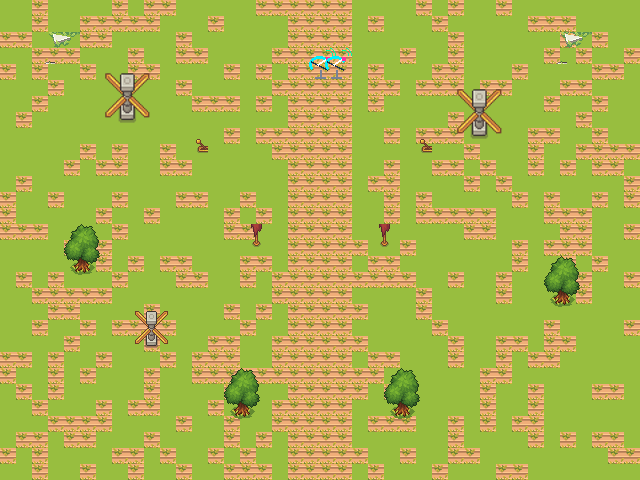
The pipeline outputs retro 640x480 pixel maps (a precise 40x30 tile grid of 16x16 pixel tiles), compiling both the final PNG graphic render and a JSON manifest containing collision matrices (walkable_grid) and canonical points of interest.
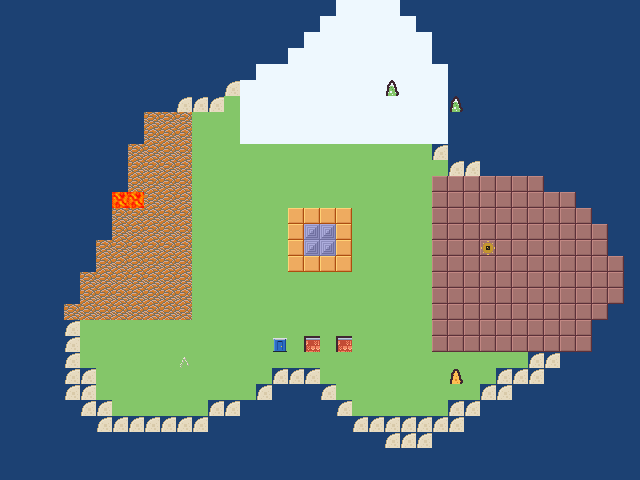
An interesting implementation detail is how organic coastlines are synthesized for locations like Coela Beach, blending superimposed harmonic sine and cosine functions to break the rigid orthogonality of grid-based maps:
1 | # Organic shoreline generation from tools/generate_all_digital_world.py |
Furthermore, the generator handles depth and collision intelligently: when placing a tree, telephone pole, or Gennai’s supercomputer, the block_base() function only marks the trunk or base footprint as unwalkable in the boolean matrix. Foliage canopies and roofs permit the Digimon’s sprite to walk behind them with genuine alpha transparency, capturing that iconic 16-bit RPG depth perception.
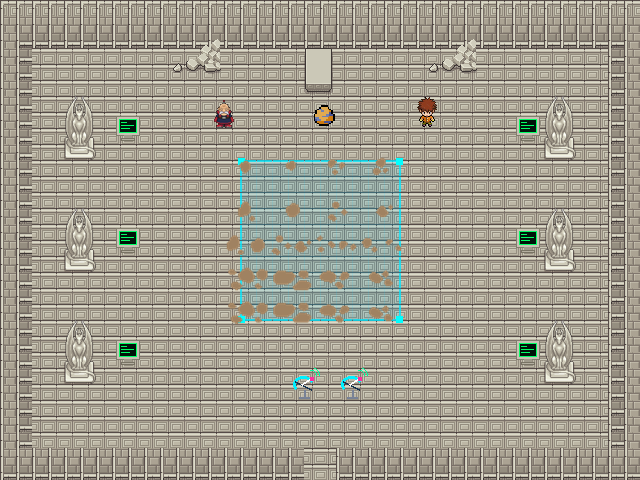
The script generates the complete canonical geography:
- Native Forest & File City
- Coela Beach & Mangrove Swamps
- Gear Savanna & Factorial Town
- Freezeland & Ice Sanctuary
- Great Canyon & Mount Panorama
- Ancient Dino Region
- Overdell Cemetery & Greylord Mansion
- Infinity Mountain & Digital Core
The Missing Piece
So far, we have a compelling cellular automaton and a map partitioned into regions governed by cyber-ethology. Left alone, the ecosystem functions like an aquarium: Digimon hatch, graze on data bits, form packs, reproduce, or get consumed by Conway’s chaotic entropy.
Yet the central protagonist is still missing: you.
How does a human player interact with a self-governing world? How do you translate the mechanical buttons and LCD alerts of a classic Digivice onto this mathematical grid? And why can a wild Digimon never reach supreme stages (Ultimate / Mega) without the discipline and bond of a Tamer?
In the third and final installment of this series, we will tackle the gameplay core: the Digivice interface, rhythmic combat with Support Megabytes, and the tactical automaton console.